
Matrix-based upstream/downstream power-flow tracing to attribute line flows and losses to individual generators and loads, enabling usage-based transmission pricing, loss allocation, and auditability from a single operating snapshot.
1) Motivation
New lines and reinforcements require cost recovery that reflects usage. Conventional postage-stamp tariffs ignore who actually uses which corridors, while nodal marginal pricing does not by itself apportion embedded network costs. Tracing provides a middle ground: from the measured/solved flows of a network state, it estimates how much of each line flow and loss is caused by each generator and consumed by each load—supporting transparent bills and what-if analysis.
Methodology
The present study uses superposition theory and fundamentals of electricity flow. This method neither uses power flow analysis result nor proportion sharing principle. Therefore, the drawbacks of existing methods are solved. Furthermore, the present method reduces the computational complexity and easy to implement
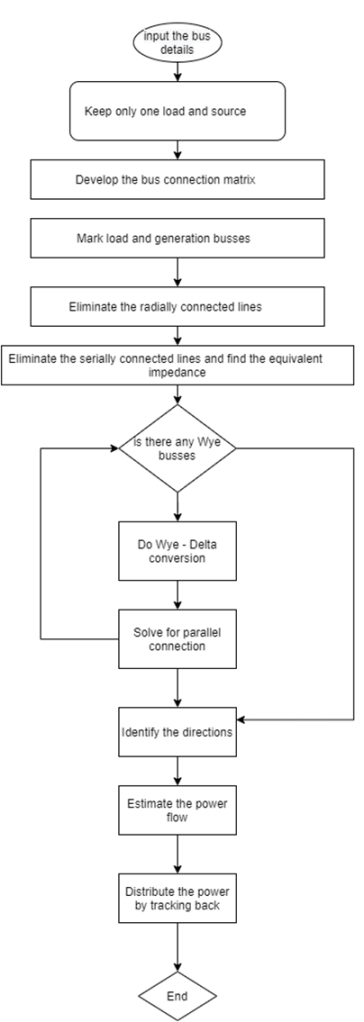
Using superposition, analyze one source and one sink at a time. First, keep one generator and one load in the network and set all other generators and loads to zero. Run the algorithm in figure 1 to compute that generator’s contribution to that load on every line and record it as a line-by-line contribution table. Next, keep the same generator, select the next load, and repeat. After all loads have been processed, add the contributions across loads to get the total per-line contribution for that generator. Then repeat the entire procedure for each generator. The final result is a complete table showing, for every generator, its contribution on each line. Below flow chart shows an over all view of the methodology.
 Sangar Shanthanam
Leave a comment